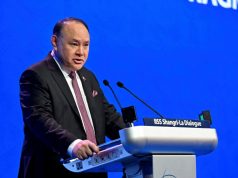


Defense Secretary Gibo Teodoro was praised for directly responding to a “disrespectful” note from the Chinese delegation that he received while speaking at the Seoul Defense Dialogue (SDD) 2026.
The Cabinet official attended the SDD, an annual multilateral security forum hosted by South Korea that promotes dialogue and security cooperation among officials and experts from different countries, from September 7 to 9.
Reports said Teodoro was participating in the forum’s first plenary, which focused on ways to build a more stable international order amid growing geopolitical tensions, when someone suddenly handed him a piece of paper.
At that time, Teodoro was discussing the dispute in the South China Sea, accusing some countries of using hostility and unchecked power at the expense of smaller states and stressing the need to uphold international law, including the United Nations Convention on the Law of the Sea (UNCLOS).
While he was speaking, a man approached and handed the Philippine official a note.
“Just like…. uh, I have a note here. I think this is from China. You should’ve joined the…” Teodoro said, adding that he would read the note.
He then proceeded and commented: “These are words slipped to me.”
“Is this the right paper to post to me when I’m being asked a question on the floor?” Teodoro said.
“It not only disrespects international law… but it also disrespects the basic decency that should be accorded to our most gracious hosts, the Republic of Korea, and the rest of the audience here,” he added.
“So, perhaps, basic decency and behavior is what China needs to do,” he said. “Now, in Filipino, maging disente lang kayo nang konti. Mahiya naman kayo nang konti.”
The Department of National Defense also posted a video of the moment, captioning it: “MAHIYA NAMAN KAYO.”
Teodoro’s actions were lauded by social media users who watched how he handled the interruption.
“You need to watch this incredible video to understand just how tired China’s neighbors are of its aggressive coercion,” Kareem Rifai, a research fellow at the University of Tokyo, said.
“Instead of acquiescing like Beijing wanted, the secretary read the note out loud, ridiculing and debunking it as he went before saying, ‘perhaps, basic decency and behavior is what China needs to do,'” he added.
“That was such an audacious act. This is an example of how the [situation] should be dealt with!!” another commented.
“There are well-established protocols to voice disagreements in an international forum. Passing a note Under-the-table style is not it. Rare to see such a strong and witty rebuttal to China in public.
Well done, Philippines!” another wrote.
“He has done a perfect thing to read it loud on the stage itself. Turn the passive aggression to Chinese officials itself,” a different X user commented.
The DND also uploaded the letter, in which China once again called the 2016 UNCLOS Arbitral Award “illegal, null, and void,” adding that it would never recognize the legal decision concerning the Philippines’ Exclusive Economic Zone (EEZ) in the South China Sea.
The EEZ is a sea zone where a coastal country has sovereign rights to explore and use marine resources. It extends up to 200 nautical miles from the baselines from which the territorial sea is measured.
Philippines’ claims on South China Sea
In 2013, the Philippines questioned the legality of China’s sweeping claims and activities in the South China Sea by initiating an arbitration under the 1982 UNCLOS dispute settlement procedures.
In 2016, the Permanent Court of Arbitration (PCA), accting under the UNCLOS, ruled in favor of the Philippines, declaring that China’s nine-dash line claim over the disputed waters had no legal basis.
The international tribunal pointed out there was no evidence that Beijing had exercised exclusive control over the disputed waters or their resources.
The PCA also found that China had violated the Philippines’ sovereign rights in its EEZ by interfering with Philippine fishing and petroleum exploration, constructing artificial islands and failing to prevent Chinese fishermen from fishing in the zone.
The Philippines was the first country to challenge China’s expansive claims over the disputed waters through arbitration.
Vietnam, Malaysia, Indonesia and Brunei also have overlapping claims in the South China Sea.