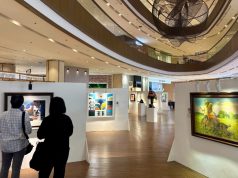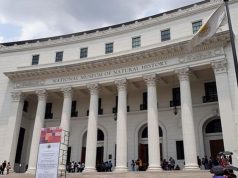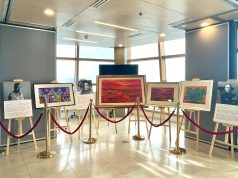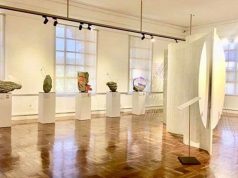

Spanish-born painter and printmaker Juvenal Sansó is the subject of SANSÓ: Pusong Pilipino, an exhibition at the National Museum of Fine Arts featuring nearly 100 works from more than seven decades of his career.
Presented by Fundacion Sansó, the exhibition looks at how Sansó’s life in the Philippines influenced his artistic development and continued to inform his work as he built an international career.
Sansó’s works in the exhibition range from pieces he made as a student in the 1940s to his Moderno Series from the late 2000s. The selection includes early landscapes, figurative works, landscapes and seascapes, floral compositions, prints, collagraphs and later paintings.
Also featured are works from his Baklad or fish-trap series, which the foundation describes as early Philippine precursors to his later Brittany series.
“Visitors will encounter important examples from his early figurative period, works produced during and after his years in Europe, celebrated landscapes and seascapes, floral compositions, prints, collagraphs, and later paintings that demonstrate the evolution of his artistic vision,” curator and Fundacion Sansó director Ricky Francisco said.
The exhibition also highlights areas of Sansó’s practice beyond painting. He worked in printmaking, textile design, fashion illustration and costume design.
Francisco said the exhibition “also revisits periods and bodies of work that have received less scholarly attention than some of his best-known paintings.”
How the Philippines shaped Sansó’s work
Although Sansó was born in Spain, his artistic consciousness was shaped by his life in the Philippines. He traveled extensively and achieved international recognition in Europe, but continued to return to the country.
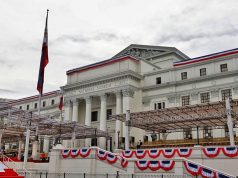
@interaksyonA MAJOR EXHIBITION AT THE NATIONAL MUSEUM SANSÓ: Pusong Pilipino explores the enduring connection between Spanish-born painter and printmaker Juvenal Sansó and the Philippines, his adopted home. The exhibition, which opened on Aug. 26, 2026, at the National Museum of Fine Arts, features nearly 100 works spanning more than seven decades of Sansó’s practice, including landscapes, seascapes, floral compositions and prints. 📷 : Interaksyon/Sammy Baynosa
The exhibition examines this connection through works from different periods of his career.
“One of the exhibition’s most significant revelations is the extent to which the Philippines remained central to Sansó’s imagination throughout his life,” Francisco said.
“The exhibition demonstrates that many of the emotional, psychological, and visual foundations of his work can be traced back to experiences formed in the Philippines.”
The exhibit includes some of Sansó’s earliest landscape paintings, created while he was a student at the UP School of Fine Arts.
It also features his Baklad series. According to Francisco, Sansó encountered the fish traps after returning to the Philippines in 1957 following six years in Europe. The images later became part of his visual language, including in works associated with Brittany.
The exhibition was curated using works from the Fundacion Sansó archives and six private collections. Its preparation involved reviewing archival records, publications, photographs, correspondence, exhibition histories and artworks.
Instead of focusing solely on the dates when the works were produced, the exhibition follows Sansó’s formative experiences in Manila, the effects of war and displacement, his international career and his eventual return to the Philippines.
“Visitors move through a narrative that begins with his formative experiences in Manila, examines the emotional and artistic consequences of war and displacement, follows his international journey, and ultimately arrives at his return to the country and the establishment of his enduring legacy,” Francisco said.
From an international career to a Philippine legacy
Sansó returned to Manila permanently in 2008 and later established Fundacion Sansó, which works to preserve his archives, library, collections and documentary materials.
The foundation also runs programs involving scholarships, grants, exhibitions, research and other forms of support for artists and cultural workers.
Artist Gwen Dionisio, a recipient of a Sansó scholarship, spoke during the exhibition reception about the support she received.
“For Mr. Sansó, this was never just about financial aid,” Dionisio said.
“It was about breathing life into dreams,” she added/
The National Museum also received six Sansó works during the exhibition’s reception on August 26. Fundacion Sansó and private collectors donated the works, which represent different periods and aspects of the artist’s career.
The donation is separate from the larger exhibition, which brings together nearly 100 works spanning more than 70 years.
The exhibition is Sansó’s first solo retrospective at the National Museum of the Philippines.
SANSÓ: Pusong Pilipino is on view at Gallery XV, E. Aguilar Cruz Hall of the National Museum of Fine Arts until February 2027.
—With Sammy Baynosa, Rosette Adel